Case study
From Better Architecture to Better Sales in E-Commerce
What began as a checkout rewrite became a full multi-brand migration: all UI to Next.js and React, and .NET Framework services to a modern .NET API.
- Organization
- Tenengroup
- Role
- Senior Full Stack Developer
- Period
- Jul 2022 — Feb 2024
At a glance
- Problem
- A template-coupled storefront made multi-brand commerce changes harder to build, test, and release.
- My scope
- Senior full-stack delivery across cart and checkout, the frontend platform, and API contracts with .NET teams.
- Key decision
- Replace server-template coupling with a Next.js and React frontend, a modern .NET API, and explicit server/client state boundaries.
- Outcome
- Cart and checkout work reduced abandonment by 20% while creating a reusable multi-brand platform foundation.
Details are limited to respect confidentiality.
A checkout rewrite exposed a platform problem
The first part of the modernization was the shopping cart and checkout for MYKA and Oak & Luna. That was where the business stakes were easiest to see: when a customer is ready to buy, slow, inconsistent, or difficult-to-change UI quickly becomes conversion friction.
The work helped reduce cart abandonment by 20%. But checkout was not the whole story, and it would be misleading to present the result as a checkout project that happened to use a new framework. Rewriting that first flow made the limits of the underlying platform clear. The same constraints would eventually affect every product page, account journey, and brand-specific experience we needed to ship.
What began as a customer-facing rewrite became a complete platform migration: the UI moved to Next.js and React, and the backend moved from .NET Framework to a modern .NET API. The purpose was not to replace technology because it was old. It was to create a system that could support several international brands, give developers reliable boundaries to work within, and make product changes easier to test and release.
The previous model tied the frontend to server templates
The legacy storefront combined .NET-rendered templates with React and Redux widgets. Server templates assembled a central state payload, then passed it to the widgets on the page.
That approach works while a page has a small number of isolated interactions. As the storefront becomes a product in its own right, the costs become more visible. A component can depend on data assembled far away in a template. It is harder to see which feature owns a field, when a particular part of the page should refresh, or whether a change to a shared Redux flow affects another widget. The backend and UI are also coupled by the template boundary: server rendering decisions and frontend state decisions become part of the same system.
The issue was not that React, Redux, or .NET were inherently wrong tools. It was that the ownership model no longer matched the scope of the product. A multi-brand commerce platform needs a UI that can grow feature by feature and an API that is a deliberate contract, not just data embedded in a page.
Rebuild the boundary, not just the screens
The migration changed both sides of that boundary. The frontend became a Next.js application with a full React client experience. The backend moved from .NET Framework to a modern .NET API. This separated application concerns that had previously met inside server templates.
On the UI, Next.js provided a modular application structure. Each feature could request server-backed data through its own boundary instead of receiving a single, centrally prepared object from .NET. On the backend, the API became the explicit integration point for the UI. That made the work easier to reason about across frontend and backend teams: a feature needed a clear data contract rather than a change somewhere inside a rendered template.
This was the architectural shift that mattered most. Framework names are less important than the result: the UI could evolve independently, the backend could serve it through an intentional API, and both sides could be developed and tested as parts of a platform rather than as pieces of a page.
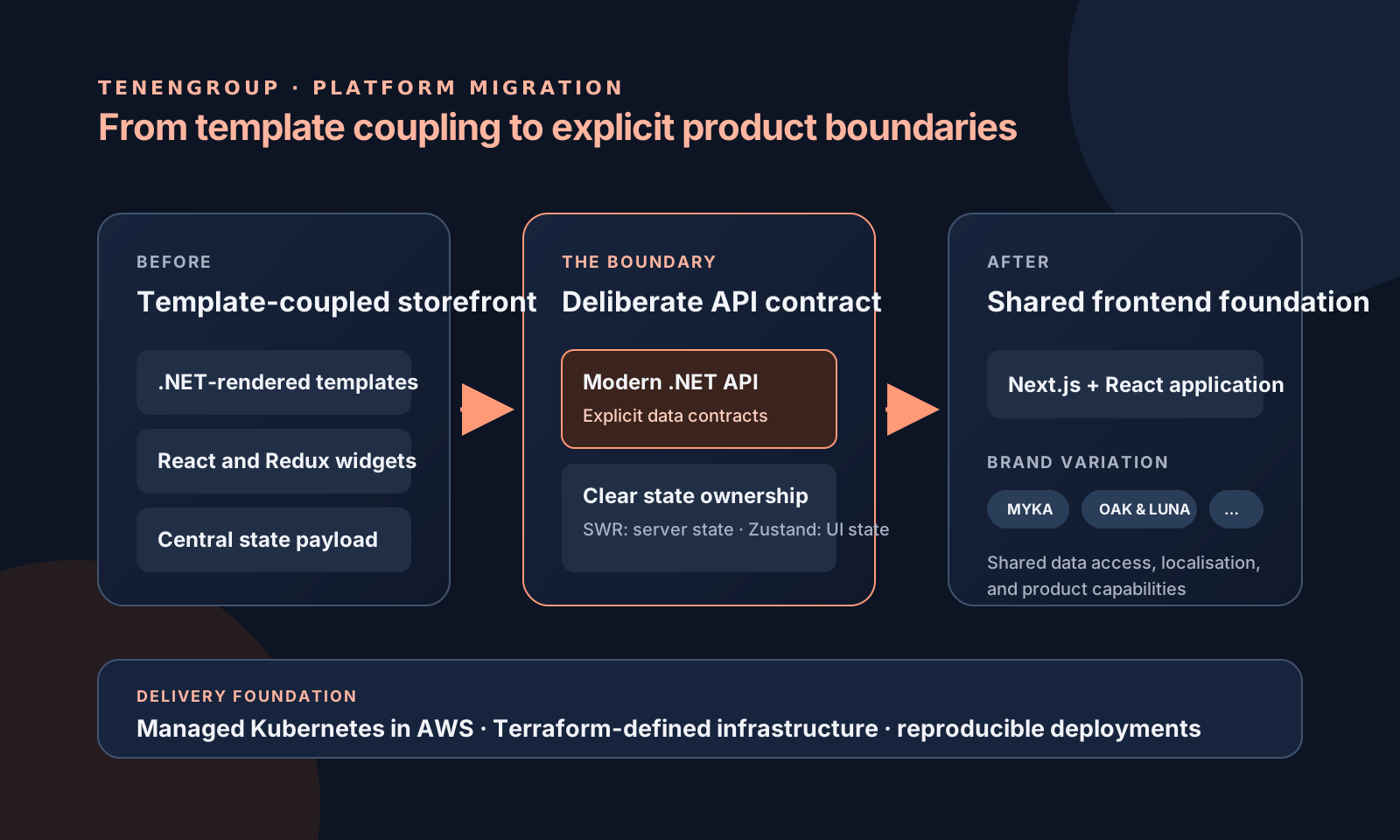
A simplified model of the migration’s intended boundaries, rather than a literal production topology: shared platform foundations, explicit API contracts, and intentional variation for each brand.
State needed two different homes
Removing the template payload was only useful if the replacement made state ownership clearer. We split it according to why the state exists and how it changes.
- SWR handled server state with a minimal React hook for fetching, caching, revalidation, and request deduplication near the feature that uses the data.
- Zustand handled client state: focused interface state that does not belong in an API response or a page-wide Redux store.
This distinction gave the frontend a simpler mental model. A feature could define what it reads from the API, how long that data stays useful, and what it does while the request is pending or fails. Transient UI choices could remain local instead of becoming a global state transition for the entire storefront.
There was a cost to this design. A central payload can look simpler because it puts all data in one place. The modular model requires each feature to be explicit about its data contract and cache behaviour. At the scale of a commerce platform, that explicitness is valuable: it reduces hidden coupling, makes stale-data behaviour easier to find, and gives developers a smaller area to test when they change a flow.
One platform had to express several brands
The platform served brands with materially different requirements. MYKA ran in more than 10 languages and needed substantial customisation. Oak & Luna had a smaller language footprint. Other products, including Lime & Lou, required their own product and visual variations.
The temptation in multi-brand commerce is to duplicate the storefront and let each brand diverge. That can make the first customisation quick, but it turns every later capability—localisation, a new commerce flow, a defect fix, or an operational improvement—into repeated work.
Instead, the shared platform allowed the brands to use the same backend while applying their own configuration, customisation, and internationalisation. The goal was not one generic brand experience. It was a common foundation for the parts that should remain consistent: data access, core commerce behaviour, operational patterns, and the ability to deliver an improvement once and adopt it where it applied.
That is where the migration earned its keep. A better architecture did not mean removing variation; it made variation an intentional configuration concern instead of a reason to fork the application.
Delivery became part of the product architecture
The old deployment process relied on Windows-based VPN access. This added friction to the development loop around a platform that needed frequent, low-risk iteration.
The modernized platform ran on managed Kubernetes in AWS, with Terraform used to define infrastructure and deployments declaratively. The environment was no longer a place developers had to reach and adjust manually; it was versioned configuration that could be reviewed and reproduced.
That delivery change was as important as the frontend migration. A clean API boundary and modular React features only improve team velocity if the team can test and release them predictably. Managed Kubernetes reduced infrastructure overhead for the application team, while Terraform made the path to deployment more consistent and less dependent on a particular machine, connection, or manual procedure.
Better architecture creates the conditions for better sales
The cart and checkout work reduced abandonment by 20%. That is the measurable customer outcome from this period, and it belongs to the customer-facing work on those flows—not to a claim that migrating frameworks alone produces sales.
The larger rewrite created the conditions for that kind of improvement to keep happening. A modern .NET API separated backend capabilities from UI templates. Next.js made the storefront modular. SWR and Zustand gave server and client state distinct, understandable homes. The multi-brand foundation made reuse possible without erasing localisation and brand-specific design. And declarative AWS delivery shortened the distance between a tested change and a real customer seeing it.
In e‑commerce, that is how architecture reaches the bottom line. It does not replace product judgment, design, or experimentation. It lets teams ship those customer-facing improvements faster, with fewer regressions and less repeated work across brands.
What I would take into the next modernization
Start with a valuable vertical slice, then follow the constraint. Checkout was the first rewrite because it had a direct customer and business impact. It also revealed the platform boundaries that had to change everywhere else.
Treat the API as a product boundary. Moving from server templates to a modern API lets frontend and backend work evolve through explicit contracts, rather than through an implicit page-rendering pipeline.
Separate server and client state on purpose. Cacheable API data and short-lived UI state have different lifecycles. Giving them different homes makes the application easier to understand and change.
Share foundations, not every brand decision. A platform should make internationalisation and customisation cheaper without forcing different brands into the same customer experience.
Design the release path with the application. Declarative infrastructure is part of delivering product value, not work that begins after the UI is done.
The useful test for a modernization is not whether the new stack looks more current. It is whether the next customer improvement is easier to build, safer to release, and possible to reuse across the business. That is the standard we were building toward.