Case study
What Building 30+ Integrations Taught Me
Building a connector catalogue for AI Studio meant solving product, access, testing, and operational problems—not just calling APIs.
- Organization
- Tolstoy
- Role
- Senior Full Stack Engineer
- Period
- Nov 2024 — Present
At a glance
- Problem
- A growing connector catalogue had to be useful to customers, safe for an AI agent, and supportable after release.
- My scope
- Full-stack engineering across customer workflows, access, testing, and operational foundations for AI Studio integrations.
- Key decision
- Treat each third-party platform as a bounded product capability, not simply an API client.
- Outcome
- Established infrastructure supporting the creation and maintenance of 30+ third-party integrations.
Details are limited to respect confidentiality.
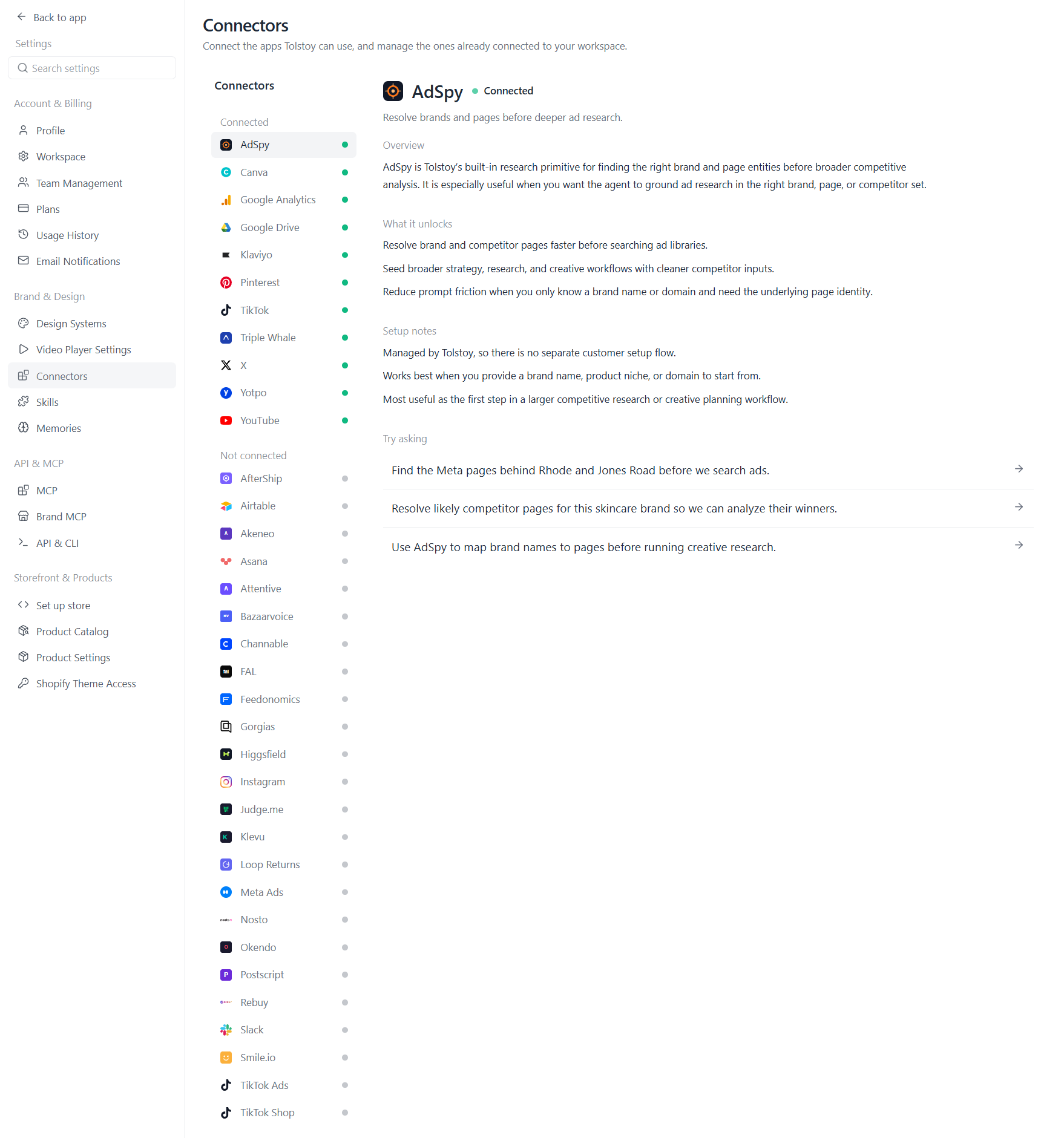
The integration problem behind AI Studio
Tolstoy AI Studio started as a harness for image and video generation. It was becoming a workspace where a team could plan, research, create, and refine content through one conversation.
The conversation was only the surface. The work a marketer needed to do was still spread across other systems: campaigns in Meta Ads, UGC discovery on Instagram, email campaigns in Klaviyo, assets in Canva or Google Drive, and performance data in Google Analytics or Triple Whale. AI Studio had to work with that stack instead of asking customers to replace it.
On paper, adding more than 30 connectors looked like work that frontier models should make routine: read the API documentation, generate a client, repeat. In practice, the hard part was turning each external platform into a reliable product capability. The customer needed to understand what they were connecting; the agent needed clear limits on what it could do; and the team needed a way to test and support the integration after release.
That is what this work taught me about AI product engineering: the API call is usually the smallest part of the connector.
One catalogue, several kinds of work
The connector page gave customers one catalogue. Behind it were several different types of integration.
Content sources such as Canva and Google Drive could bring images, videos, and brand materials into AI Studio. Marketing and analytics platforms such as Meta Ads and Google Analytics provided campaign and performance context. Customer platforms such as Klaviyo added a third category: information about email campaigns and the customer relationship.
Those categories could share a UI, but not an implementation. Asset workflows needed imports and exports. Analytics workflows needed the right account and data selection. Customer-data workflows needed especially careful access boundaries. Treating every logo as the same kind of connector would have made the product simpler to build but less useful and less clear.
OAuth made onboarding easier for customers and harder for us
An API key integration was usually quicker to implement, but it placed work on the customer: they had to find out how to create a key, then copy it into Tolstoy. OAuth 2.0 was more comfortable for the customer, but demanded more from us. It introduced consent, scopes, account selection, token refresh, and reconnect flows.
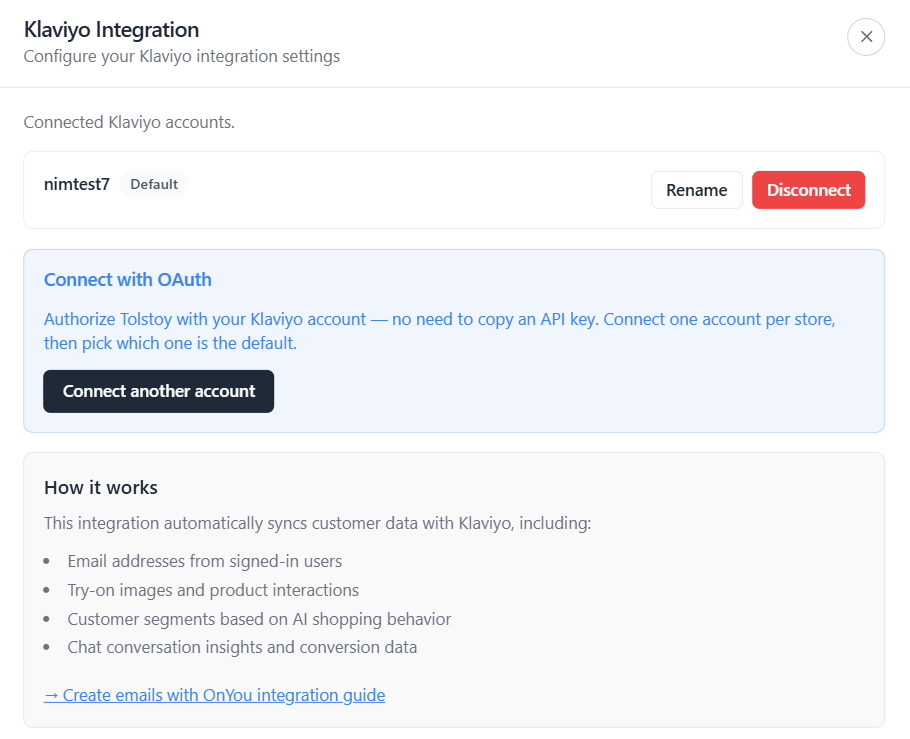
The intended customer experience: connect an existing account through OAuth, choose the default account for a store, and avoid creating and copying an API key.
It also created work outside the codebase. Registering an application with a third-party platform could require a manual submission, a video demonstration, and a review, as it did for services such as TikTok or Klaviyo. The catalogue had to make that reality visible: what was connected, what still needed setup, and what had to be reconnected after a provider change or a new capability required additional scopes.
A connector needs two interfaces
Getting data into AI Studio was only half of the job. A connector also needed to be clear to the person setting it up and to the agent deciding how to use it.
The customer-facing interface had to answer simple questions without forcing users to understand provider terminology: What is this service? What will it connect? What can I do after I connect it? Naming mattered more than it first appeared. Customers sometimes used “TikTok” to mean TikTok Shop, or the other way around. Those are different products with different intentions, so we used explicit names and clarification messages instead of guessing.
The agent needed the same precision. It had to know which connector it was working with, what data was available, and which actions were appropriate. A generic instruction to “use TikTok” was not a capability definition. Clear names and bounded behaviour made the product less surprising for customers and more reliable for the agent.
API documentation was only the starting point
Generating a request was quick. Proving that it worked for a real customer was not.
Provider documentation could lag behind the behaviour we encountered, or assume a subscription tier that a development account did not have. Some connectors required a paid plan, an API key, or a provider-approved test account before we could validate a meaningful workflow. A successful response from an endpoint was not enough. We needed to know that the right account, permissions, and data were available in the way a customer would actually use them.
That shaped the delivery process. We first established access and a narrow end-to-end workflow, then released the connector in beta for testing. Beta was not a disclaimer for unfinished work. It set an honest boundary while we validated the connector against real accounts, provider behaviour, and customer feedback before expanding its capabilities.
Skills for judgement, tools for action
That boundary shaped how we designed AI-facing capabilities. The question was not whether every connector should have the same number of skills and tools. It was which parts of a workflow required judgement and guidance, and which needed an explicit operation.
We used skills when the agent needed context: how to interpret a connector, how to sequence a workflow, or when to ask the customer for clarification. We used explicit tools for bounded operations, such as retrieving information or performing a well-defined action. This kept the agent’s choices visible and gave us a clearer place to control what each connector could do.
The TikTok naming problem shows why this separation mattered. An ambiguous request could require clarification about whether the customer meant TikTok, TikTok Ads, or TikTok Shop before the agent took action. A skill could hold that guidance; once the target was clear, a tool could perform a bounded operation against the selected platform.
The balance varied by connector. A small, focused integration needed less guidance than one that combined account selection, analytics interpretation, and several actions. Skills therefore needed to stay compact and specific. At the scale of a connector catalogue, unnecessary instructions make the agent harder to steer and make every workflow more expensive to maintain.
Releasing a connector also meant operating it
The work did not stop after a connector reached beta. Tokens expired, external interfaces changed, customers connected unexpected account configurations, and new product capabilities sometimes required additional scopes.
We used AWS monitoring and dedicated Slack channels to make those failures visible and actionable. The operational question was rarely just “did the API call fail?” It was whether the problem came from the provider, expired access, an account configuration, a change in available data, or our own integration. That distinction determined what needed to happen next and who could resolve it.
The public outcome
AI Studio infrastructure supported the creation and maintenance of more than 30 third-party integrations. I cannot share a public delivery-speed or adoption metric, but the work established a repeatable path: define the customer workflow, make the capabilities explicit, establish real access and testing, release a bounded beta, and keep operating the connector after launch.
What I would carry into the next integration project
Start with the workflow, not the API. A connection only matters when a customer understands what it unlocks and can use it in their existing work.
Treat access and testing as delivery work. OAuth, provider approval, test accounts, and account configuration affect scope and schedule just as much as the implementation does.
Give the agent explicit boundaries. A connector needs clear names, focused skills, and explicit tools where an action must be bounded. That is how a growing catalogue remains useful rather than becoming a collection of logos.