Case study
2017, Before LLMs: The Patient Rewrite of Yandex.Disk
How a live Yandex.Disk product moved from an internal frontend framework to React 16 and Redux—without stopping feature delivery.
- Organization
- Yandex
- Role
- Interface Developer
- Period
- Jan 2017 — Mar 2019
At a glance
- Problem
- A live product needed to move from an internal frontend framework to React without pausing feature delivery.
- My scope
- Interface development across the React bridge, interaction-heavy components, and the move to explicit Redux flows.
- Key decision
- Use a compatibility layer and migrate the product in release-safe steps instead of attempting a replacement launch.
- Outcome
- The broader frontend modernization reduced page-load time by 20%; the improvement cannot be attributed to one migration step.
Details are limited to respect confidentiality.
The rewrite we could not pause the product for
In 2017, there was no ChatGPT to sketch a migration plan, no Copilot completing the tedious parts, and no ready-made playbook for turning a large, live product into a single-page application. We had React 16.0, Redux, a mature product used every day—and a rewrite we could not afford to pause the roadmap for.
From production’s point of view, the project looked like a new design for Yandex.Disk. Under the surface, it was a larger change: a gradual replacement of the frontend architecture. We wanted to move to a React-based SPA, but new features, improvements, and fixes still had to reach users throughout the migration.
That constraint shaped every major decision. The goal was not to make the legacy system disappear in one dramatic release. It was to make the next piece of the product easier to build in the new architecture while the current product kept working.
The real limitation was an internal technology boundary
The existing application used yandex-ui/noscript, an internal frontend framework. The framework’s details are not the point of this story. Its position in the system was: it was technology specific to our environment, without the wider ecosystem, hiring pool, or long-term momentum we expected from a mainstream frontend stack.
It had supported a substantial product, so this was not a rejection of the past. The product had simply outgrown the cost of maintaining a frontend model that few engineers already knew and that no longer aligned with where frontend development was heading.
React was the target because it gave us a familiar component model, a growing ecosystem, and a way to build a long-lived application from composable UI. Redux was the practical state-management choice of the time: a well-understood way to make application state and transitions explicit across a large interface.
TypeScript was not part of the initial target stack. In 2017, it still felt too early for us to make it a foundation of a large migration. We adopted it later, once the JavaScript and React architecture had become stable enough to benefit from gradual typing.
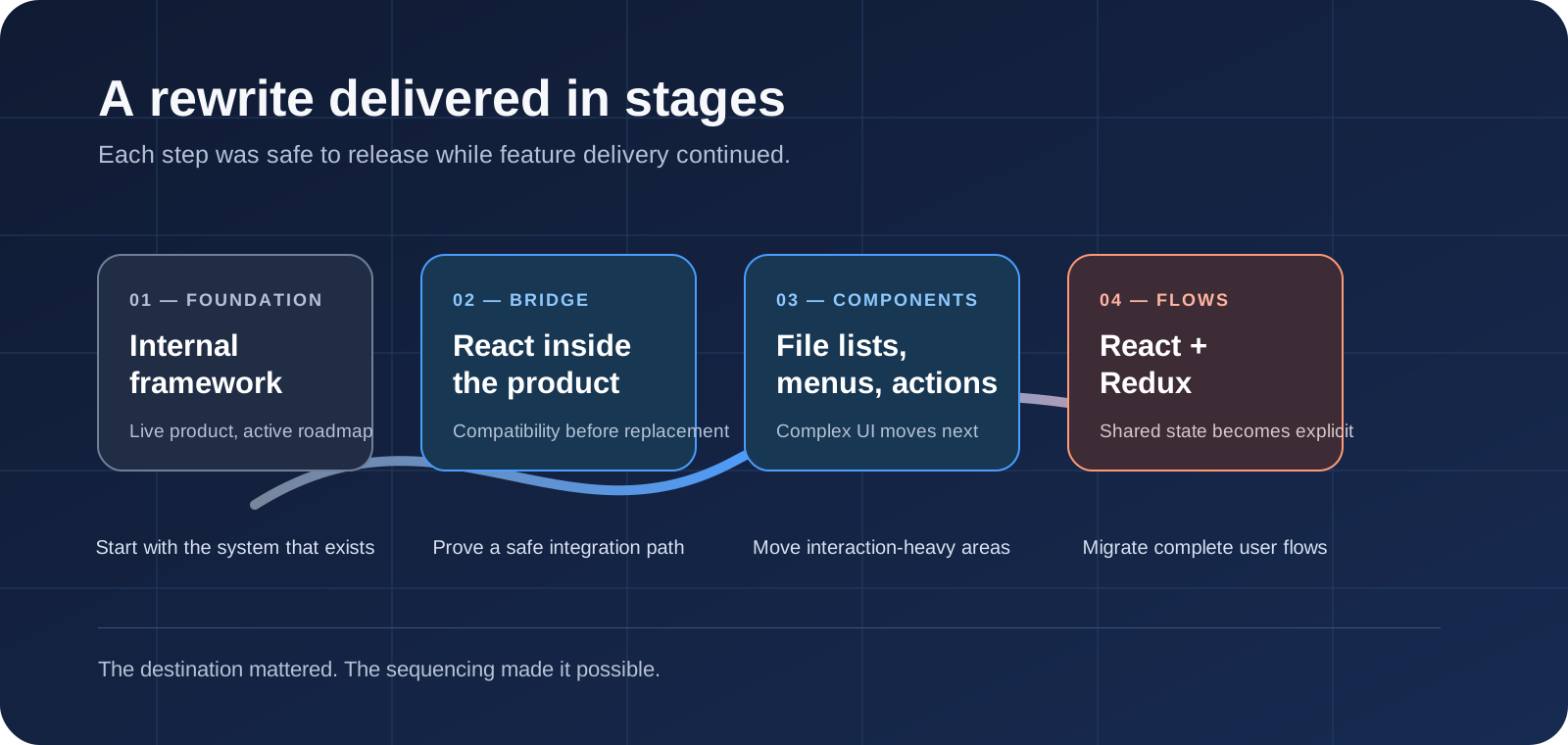
The migration was a sequence of release-safe steps, not a separate replacement project.
A bridge made gradual change possible
We began with yandex-ui/noscript-react, which let React components participate in the existing application.
This was the critical first move. We did not need to convert every page, replace all state, or recreate the application shell before React could add value. We could introduce small React components into the live product and learn the real integration constraints as we went.
The first migrations were small UI components: parts of the interface with a limited responsibility and a narrow surface area. This gave us a low-risk place to establish conventions for passing data, sharing UI behaviour, testing, and reviewing React code alongside the existing application.
In a rewrite, the first component is rarely important because of what it does for the user. It is important because it shows whether the team has found a safe way to introduce the new world.
Components were the entry point; flows were the destination
Once the bridge was proven, we moved to larger interface elements: file lists, menus, and context menus.
These were not merely bigger versions of buttons and labels. A file list brings selection state, loading states, item types, bulk actions, and updates made elsewhere in the interface into one place. Menus and context menus depend on what a user selected, where they clicked, which actions are permitted, and what must update after an action completes.
Migrating these pieces forced us to move beyond isolated rendering. The React component model made the UI tree clearer, but the consequential question became where state lived and how changes travelled through the product.
That was where Redux became useful. We began migrating complete flows into explicit state and actions instead of treating every new React component as an island inside the old application. Shared state could have a deliberate home; user actions could become visible transitions; and React components could render from a predictable source of truth.
The order mattered. Starting by moving all application state to Redux would have created a large abstraction project before proving that the UI could coexist with the live product. Stopping at visual components would have kept the most difficult coupling in place. The patient route was to earn each next step: embed React safely, migrate meaningful UI areas, then move the state and flows that made those areas behave as one application.
The awkward middle was an intentional part of the design
There is a particular discomfort in a gradual rewrite: you are knowingly building temporary seams into a system you eventually want to simplify.
For a while, old and new technologies coexisted. The team had to decide, feature by feature, where new work belonged and how it connected to the rest of the product. Sometimes the right first step was a small React component. Sometimes it was worth moving a whole interaction model because leaving it behind would only deepen the coupling.
The important discipline was not pretending that every new line of code already belonged to a perfectly clean end state. It was making every transitional choice intentional:
- Does this change create a reusable foothold for later migration?
- Can it be released safely in the current product?
- Does it reduce future dependence on the internal framework?
- Does it keep the path toward React and Redux clearer rather than creating another permanent hybrid?
That work is less cinematic than a launch-day replacement. There is no single moment when the old application becomes the new one. Instead, the rewrite becomes real through a sequence of ordinary releases.
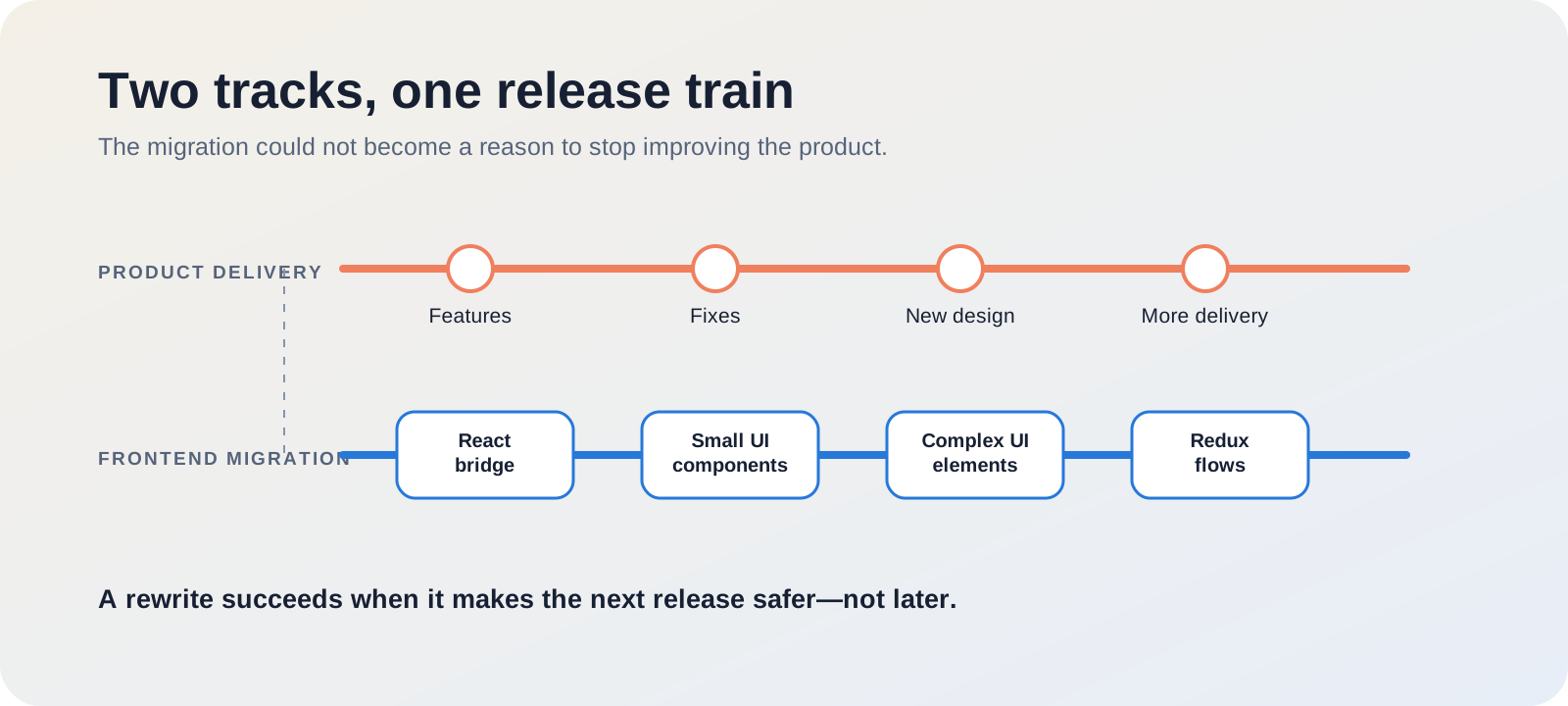
Feature delivery and frontend migration ran as parallel tracks on the same product, rather than competing projects.
Why the pre-LLM context still matters
It is easy to look back from an era of AI coding assistants and assume that a migration’s difficult part is producing code faster. In 2017, the limits were more obvious. We relied on code review, local understanding, careful decomposition, and the accumulated context of engineers who knew how the product actually behaved.
That made architecture choices more consequential. A bad boundary would not be cheaply explained away or quickly regenerated. A premature state model could spread across the application. And a migration that blocked feature work would not be rescued by a burst of generated implementation.
The tools have changed. The durable part of the work has not. An assistant can help implement a compatibility layer or suggest a Redux shape, but it cannot decide which slice of a live product is safe to move first, what compatibility cost is acceptable, or whether a team can keep delivering while an architectural change is underway. Those remain product and engineering judgements.
The rewrite was a delivery strategy
The useful lesson from the Yandex.Disk migration is that a rewrite is not only a technical project. It is a delivery strategy.
The strategy worked because we did not require the organization to choose between a better architecture and a working product:
- Introduce React through a compatibility layer.
- Migrate small UI components to establish safe patterns.
- Move interaction-heavy elements such as file lists and menus.
- Migrate shared state and complete flows to Redux.
- Continue shipping product work while the old framework steadily lost ground.
The broader Yandex.Disk frontend modernization reduced page-load time by 20%. I cannot publicly separate the measurement or attribute that result to one migration step, but it was a useful reminder that modernization only earns its keep when users feel the difference.
The new design made the change visible to users. The staged migration made it survivable for the team.
What I would take into the next rewrite
Start with a bridge, not a declaration. A compatibility layer is not glamorous, but it can turn a risky replacement into a sequence of testable releases.
Use components to learn, then migrate flows to finish the job. Small UI elements are an excellent entry point. Shared state and complete interactions are where the architecture actually changes.
Treat transitional code as a product of its own. It needs clear ownership and a clear purpose: enable the next migration step, not become a second permanent framework.
Keep feature delivery inside the plan. If a migration assumes the product can stop evolving, it is solving the wrong problem for a live business.
Do not confuse modern tools with engineering judgement. Today’s tools can accelerate implementation. They still do not replace choosing boundaries, sequencing risk, and preserving user value throughout a change.
The patient rewrite was not the fastest route to a clean React application on paper. It was the route that let us build one without asking Yandex.Disk—or its users—to stand still.